Friday, February 10, 2012

The garden begins!

From such humble beginnings will come delicious delights! We have invited chard, arugula, cabbages, kales, and lettuces to awaken from their slumber. They have acquiesced, and there are tiny taproots beginning to crack through the testa.

Marie and I have been busy in the garden; we've been forking, hauling, mulching, forking, hauling and mulching. Kevin has been building us a greenhouse so we can start more of our own bedding plants and passively heat our house, too.

The winter has been unusually accommodating this year, so we are done with almost all of the beds. We're going to put carrot seeds in the ground after the cold spell this weekend.

We're really excited about this year's garden. We're doing several more varieties of tomatoes this year--35 to be exact. We're also adding two new varieties of cucumbers, but we won't be trying Hmong Red cucumbers again, as they were a total flop. We have a new Yard Long (Chinese Noodle) bean--Purple Podded, which should look stunning with the Red Yard Long beans we grew last year. We're hoping for significantly more pole beans this year--yellow, purple, green, and striped.

The greens bunches will be mind boggling. We're adding Pink Lettucey mustard and Green Wave mustard, as well as a new mix of kales from FedCo. On the lettuce front, we've added the Freedom Mix.

The mustards and lettuce are all from Wild Garden Seed. They are one of the producers involved in the lawsuit against Monsanto. We are proud to support many of the producers fighting for our liberty and the future of our food supply.

We are months ahead of where we were this time last year. This year we're armed with our broadfork and a full season's experience. We're also getting an above ground pool to use as a cistern.

God willing and the creek don't rise, 2012 should be a fantastic year here at Purple Maize Farm.

Seed catalogs

There's a special, splendid kind of torture a gardener experiences when the splashy seed catalogs full of lush pictures of perfect produce start piling up in the mailbox. Nothing insulates against a cold, gray morning better than a gardener's growing fantasies, fertilized by the promise of flowers that will make your eyes pop, tomatoes that will make your neighbors' mouths water, okra with pods that can grow three feet long and stay tender, a clematis that will grow 35 feet in a year. All things are possible in the throes of a February delirium.

Right now the bare branches of the trees allow us to admire the dramatic intricacy of arboreal sculpture. The silhouettes of the naked trees trace a lacy outline of the lay of the hills against the neon winter sunsets. Only now, while the weeds are planning this year's ambush, can you fully appreciate the enormity of the rocks that lay strewn beneath the trees. Now is the time for hiking without the threat of ticks. The ridge tops offer beautiful views of hollows that are usually hidden behind a profusion of green, red or orange, or brown.

There is plenty of beauty to be appreciated in the dormant season, but a gardener's heart longs for the chaotic explosion of green, the pops of electric reds, fluttering oranges, floods of yellow, purple, blue. Right now I'm anxiously anticipating the time to start my early cabbages and kales, mustards, lettuces, and soon after that, the tomatoes. I'm tingling with excitement to watch the determined taproots explode from tiny, dry seeds and dive into the dirt, to see the delicate cotyledons break through the surface of the soil. There is nothing so satisfying as see your squash and been plants double in size in a day.

Many seed catalogs that focus their offerings on hybrid varieties have begun featuring heirloom and open pollinated varieties. There are also a number of fantastic catalogs that focus exclusively on collecting, maintaining, and offering such varieties.

The Baker Creek Heirloom Seeds catalog is as beautiful as it is informative. Its pages are filled glossy photographs so vivid you can almost smell the sunshine in the striped tomatoes. The descriptions for the varieties include stories about where the seeds were collected, from South America or India or Afghanistan. They have pink bananas, striped melons, red lettuce, green zinnias, and everything in between.

Southern Exposure Seed Exchange also offers a fantastic collection of open pollinated varieties. Their description of the cucumber leaf sunflower they offer says that birds prefer the seeds this drought-tolerant, Gulf Coast native to other sunflower varieties. The catalog has great planting tips and directions. They offer a large collection of herbs, flowers, vegetables, potatoes, garlic, grains, and even cover crops.

Seed Savers Exchange maintains thousands of varieties of different food plants, ranging from grains like quinoa and amaranth to garden familiars like tomatoes and watermelons. They manage one of the largest seeds banks of its kind in the United States. They are able to maintain this level of diversity through participatory preservation. As stated on their website, seedsavers.org, “Each year thousands of seed varieties are exchanged among backyard preservationists through the Seed Savers Exchange Yearbook for diverse reasons such as connecting to our garden heritage, finding varieties suited to a particular region, enjoying the diversity of heirloom varieties, and sourcing material to use in localized breeding projects.”

These are just a very few of the many fantastic seed companies fighting diligently to maintain our access to the genetic variety that generations of growers have cultivated. Many small seed companies in this country have gone the way of the small family farm and small family business; they have been bought out or bumped out by megalithic corporations.

There is a trend in agribusiness towards seeds that farmers cannot save from year to year, putting them at the mercy of the company that owns the seeds. There is another, more insidious trend toward the patenting of the genetic content of seeds.

Like open source software, which is offered free for public use and can be improved upon by subsequent innovation, open pollinated seeds offer genetic material to farmers and gardeners freely. They are legally free to make improvements to and selections from these varieties, which they can then offer back to the seed saving community.

Maintaining a robust supply of genetic information, or a variety of adaptations, makes for a resilient food supply. If you grow several bean varieties, one that does well in drought, one that tolerates hot and humid weather, and another that will flourish in cooler weather, you're more likely to have a good crop of beans, even if the weather isn't ideal that season. In contrast if you have 100 acres of plants with exactly the same genetics, if you encounter a condition to which one plant is susceptible, you're more likely to lose your whole crop.

The mind boggling diversity of open pollinated varieties will keep you reeling for weeks as you thumb through all the catalogs, trying to decide which Italian sweet pepper, French cucumber, or Russian tomato to try this year. No matter where you get your seeds, the beauty of spring in the garden is made of endless possibility, infinite potential, and the promise of sun drenched culinary delight.

Friday, January 27, 2012

Goats

These are my two most recent DeKalb County Times columns about our experience thus far with baby goats. There are many, many more pictures of the kids on our facebook page.

1/18/2012

We live in a place where goats and sheep still dot the pastoral landscape, blithely nibbling on the weeds and vines that pickier ruminants find less palatable. Some farmers keep goats to keep their fence lines clean or hilly acreage from going to prickly blackberry vines, thorny locust trees, and cedar trees. In addition to their landscaping services, goats can provide entertainment, companionship, milk and milk products, and meat. You may have heard the expression, “He really got your goat.” It's not just the loss of a cloven hoofed friend that would drive someone to use some variation of that line. The expression comes to us from the horse racing world. Horses are social animals, so being taken from their home herd and kept in confinement during travel can be extremely stressful to a racehorse. Since horses are also large animals it is inconvenient to ship a racehorse along with a horse friend, so sometimes racehorses are given a goat friend who can travel with them. If an immoral competitor takes your racehorse's goat—being the flighty, emotionally fragile creatures that they are—the theft may leave your horse so bereft that he will not be fit to win the race. Quite literally, that scoundrel “got your goat.”

It's kidding season right now in our area for people who are fortunate (or unfortunate) enough to have goats. Our farm is counted among those. Our headcount started at four, including only one male. The goats came from a herd where the males and females were kept together all the time. When I asked a friend who raises goats if he thought the females were bred, his answer was, “Well, if they ain't, you should shoot that billy.”

Thirteen days ago, at approximately 11:15pm, we heard one of our goats make a strange noise. We were expecting, though not prepared for, kids. We rushed into the cold night and found a single baby goat gurgling sad little noises through the placenta leftovers that its mother was not cleaning off of it. We cleaned the baby and tried to help it nurse, but its mother wanted nothing to do with the baby, and her milk wasn't flowing. Being both unprepared for and unwilling to take on bottle feeding a baby, we closed the baby in with the mother and went back to bed. In the morning the kid was still alive but cold, so we brought it inside and warmed it up. A friend came to pick up the baby, and together we were able to get the mother's milk flowing, and the kid had its first drink of colostrum.

Colostrum is a the first milk produced by any mammal mother. It contains high concentrations of nutrients, and it's important that newborns get a bellyful as soon as possible. It boots up the baby's immune system and kicks their little bodies into a new modality of being: life outside the womb.

That day we absolutely affirmed our decision that we have no interest whatsoever in going into the goat business. We hauled our billy and the newly not-pregnant female to a goat sale that day. That evening the two remaining females started groaning and stretching. In shifts we checked on them every two hours that whole night. At seven in the morning I woke up and looked out my window at the goat pen just in time to see the first kid drop.

In ten more minutes that same female had given birth to two more kids, and she was doing a great job cleaning them off. Our other nanny was helping to clean the mewing newborns until she went into labor herself. In quick succession she dropped twins. The black one came out flailing, and both moms got busy cleaning up those babies.

There were a few gaps between the boards of our goat manger. Immediately the more agile of the wobbly legged babies toddled to the gap, thew her still-elastic legs through the space, and started hobbling through. Commandment One for being a goat: break fence.

Then the suckling began. Except all the teats were blocked with wax plugs. It's as disgusting as it sounds; little bits of dirt, skin, and detritus that block up the teat. We soaked the teats in warm water and then squeezed. All that practice in middle school squeezing pimples came in handy. Finally the milk came in a solid stream, and we helped each of the babies get a bellyful of colostrum.

But the milk was only flowing on one of the moms, Dolly, who has turned out to be a super mom. She allows the other female's babies to nurse with her own. After several sessions of soaking Mildred's abnormally long teats and massaging her alarmingly huge utter her milk finally came. We held her still and helped her twins nurse then milked her to alleviate some of her obvious discomfort.

The next morning one of Dolly's three babies was writhing with his head flopped back in a horrible position, and he was making a pathetic, sad little noise. His mouth was cold, and his eyes were lolling around in their sockets. We warmed up some milk from the night before and bottle fed him by holding his head up, prying his mouth open to squirt in the milk, then massaging his throat to make him swallow, all while holding him against us to warm him back up. The energy it takes to carry out the digestion process helps keeps new kids warm. After a few swallows we took him upstairs in basket and tucked him in with a warm water bottle. A couple hours later I fed him again. When I was feeding him again a few hours later his head flopped back and he died. Just like that.

The other four babies spent the day nursing from Dolly and being coddled by Mildred. When we checked on them that night they were all snuggled in a pile. The next morning one of Mildred's kids laid down and his head flopped back. He died a couple hours later.

When this paper comes out the remaining three kids will be two weeks old. We have been giving Mildred warm sage tea with honey to dry her up because none of the kids were able to nurse from her low-hanging teats, and she's not socialized well enough to be a calm milk goat. She's drying up quickly, but she stays in the pen with the kids while Dolly takes nursing breaks to mow our neighbor's yard in exchange for free organic fertilizer.

Of our three remaining kids, we have a female from each mother and one male. We've named all three: Geri, Sandy, and Rocky, and we're smitten with them all. But we are not a hobby goat farm. We're a market garden farm, and our garden keeps us busy year round, whether there are plants in it or not. We have no plans to breed the two mothers again. They're both old, and Mildred can't nurse. We will breed and subsequently milk one of their daughters next year, but it won't be to little Rocky. Our plan for Rocky is to raise, slaughter, process, and eat him ourselves.

___________________________


1/25/2012

One of the most rewarding parts of gardening is watching a diminutive, dry seed undergo the metamorphisis that turns the seed into a seven foot tall tangle of serrated leaves and vines laden with glistening ripe tomatoes, then to a shriveled heap of nondescript rotting plant material, and ultimately into an indistinguishable component of the soil.

Equally rewarding, but more emotionally charged, is the undertaking of raising your own animal for meat. Styrofoam and cellophane packaging put the production of meat at a comfortable distance from the consumer, the eater. I've heard many people say that they eat meat but could never kill an animal or that they don't even like handling raw meat. In my opinion that is an outrageous affront to the life that hunk of meat represents.

The farmer that raises animals for meat sees that animal's life through, from beginning to end. If the birthing is difficult, maybe the farmer has to assist the mother. If the newborn is weak or abandoned sometimes it will have to be bottle fed, hand raised. If the birth occurs in cold weather the infant might need to be brought into the house to be warmed by the stove or heater. All this for the same animal that will soon be killed, slaughtered, and eaten.

For the homesteader or small farmer, the relationship between animal and human caretaker can be even more intimate. We know and have a personal relationship with each of our five goats. They have distinct personalities, behaviors, and even distinct grazing area preferences. If we had two hundred goats, there wouldn't be enough time in the day to get to know each one. One of our herd of five is a three week old male named Rocky.

When Rocky came out he looked meager and weak. He didn't mew as loudly as his siblings, and it took him longer to hobble to his feet. Now he is an enthusiastic nurser and gaining weight quickly. He is rambunctious and loves to leap straight up, all four feet in the air. He just melts into a puddle if you pick him up and put him on your lap. His horns are coming in the fastest and are already poking above his rock hard little skull.

However we don't want him to breed his mother, aunt, sister or cousin, which he can do as early as eight weeks. So we have decided to raise him for meat. When he has fattened up a little we will carry out the entire process ourselves, from shooting him, to slaughtering him, and ultimately, to having a party with all of our friends to eat him.

Many commercially raised animals do not live fulfilling lives; that is, as Joel Salatin puts it, they're not able to express their animal-ness. Cows are on this earth to eat grass, chickens to scratch dirt, and goats to break fences. When you keep a cow shoulder to shoulder with his compatriots and knee deep in muddy manure, he is not able to express his cow-ness.

Temple Grandin has done much to revolutionize the slaughterhouses that turn cows into hunks of beef. Her systems are often simple and are designed for cows, not for the people in charge of the cows. Her autism allows her to see the world in a way much more similar to the way animals see the world than the way humans without autism see the world. Thus she is able to design ramps and runs that cattle blithely and calmly make their way through, making the process more efficient, and ultimately more profitable, for the processor.

We raise our animals by trying to take a similar approach. What is goat-ness? For brush goats, it seems to be climbing on rocks, tearing honeysuckle vines out of trees and fencelines, sunny warm days, and a general abhorrence for both fences and cold, wet weather. These are the things we will try to provide to Rocky while he's with us. He gets to bound across our rock walls and headbutt his sister on these glorious, unseasonably warm days we've been having. He nurses as much as his grumpy mother will allow, and he has a heat lamp and clean, soft hay to sleep in. When he's done nursing, he'll have as much green grass and honeysuckle as he cares to forage for, hay, and the ultimate farm treat, a little grain every day.

He also has three adoring humans who are happy to scratch his head and butt. He'll have every opportunity to express his goat-ness however it pleases him, until one day when he'll be eating a little bit of grain, and then, for him, everything will end. Just like that.

It will be gratifying to eat an animal that I know had a healthy, gratifying life. I will know exactly what medications, hormones, or supplements were or were not used in his lifetime. I will know what he ate. I'll see his insides and will know if he had a healthy liver. We'll probably eat his liver. I'll know that he died a painless, instant death.

We thought about naming him Steak or Porkchop, but we ended up with Rocky. He's the plumpest of our three babies, and I think about how delicious he'll be when I'm petting his fat little belly. We are truly enjoying his presence, and we don't snuggle him any less frequently than we snuggle the two females, who we'll keep and breed next year. I have no compunction with raising this adorable little animal with the intention of eventually killing him. If we are able to provide him a stress-free life and stress-free death with lots of grass and few fences in between, I see no moral objection.

For me, personally, the killing of the animals we eat is the worst part; I don't mind the processing at all. I hate killing the chickens, and I'm not looking forward to killing Rocky. I believe that if everyone had to kill their own animals for meat, everyone would eat a lot less meat. We appreciate the chicken stock we have in freezer and savor those pots of chicken and dumplings. We eat a lot more deer than we do chicken since chicken is way more labor intensive to come by on a pound per pound basis. I am happy I don't have to raise my own cows, so I gratefully pay my neighbors for their cows and happily work-trade with my friends for their milk.

All the meat we consume, whether from the store, the forest, or a farm, came from an animal that to some extent had an internal life—that was aware of its own existence. That you didn't personally shoot, behead, or slaughter the animal in the grocery store doesn't make you any less responsible for its death. The hands-on raising of an animal for your own table heightens your awareness of the sentience of the animals whose lives we take for our sustenance. Slaughtering an animal forces you to inspect in every visceral detail the condition of the animal at the time of its death; if you had poor management practices, you'll see the pocked liver or stressed condition of the organs.

The entire undertaking provides you an opportunity to ponder questions like, “If goats have preferences, does that mean that they have thoughts? If animals have thoughts, what differentiates animals thoughts from human thoughts, or animal experiences from human experiences? Do dogs and cats have a richer internal life, or heightened level of sentience, than a goat? Where do human babies fall on the scale of sentience and richness of internal lives? At what level of sentience does it become morally reprehensible to eat an animal? If you didn't have opposable thumbs, how would you kill a goat?”

Or even if your mind doesn't wander that far, at least in the end you get a full belly on account of those opposable thumbs.

Wednesday, October 12, 2011

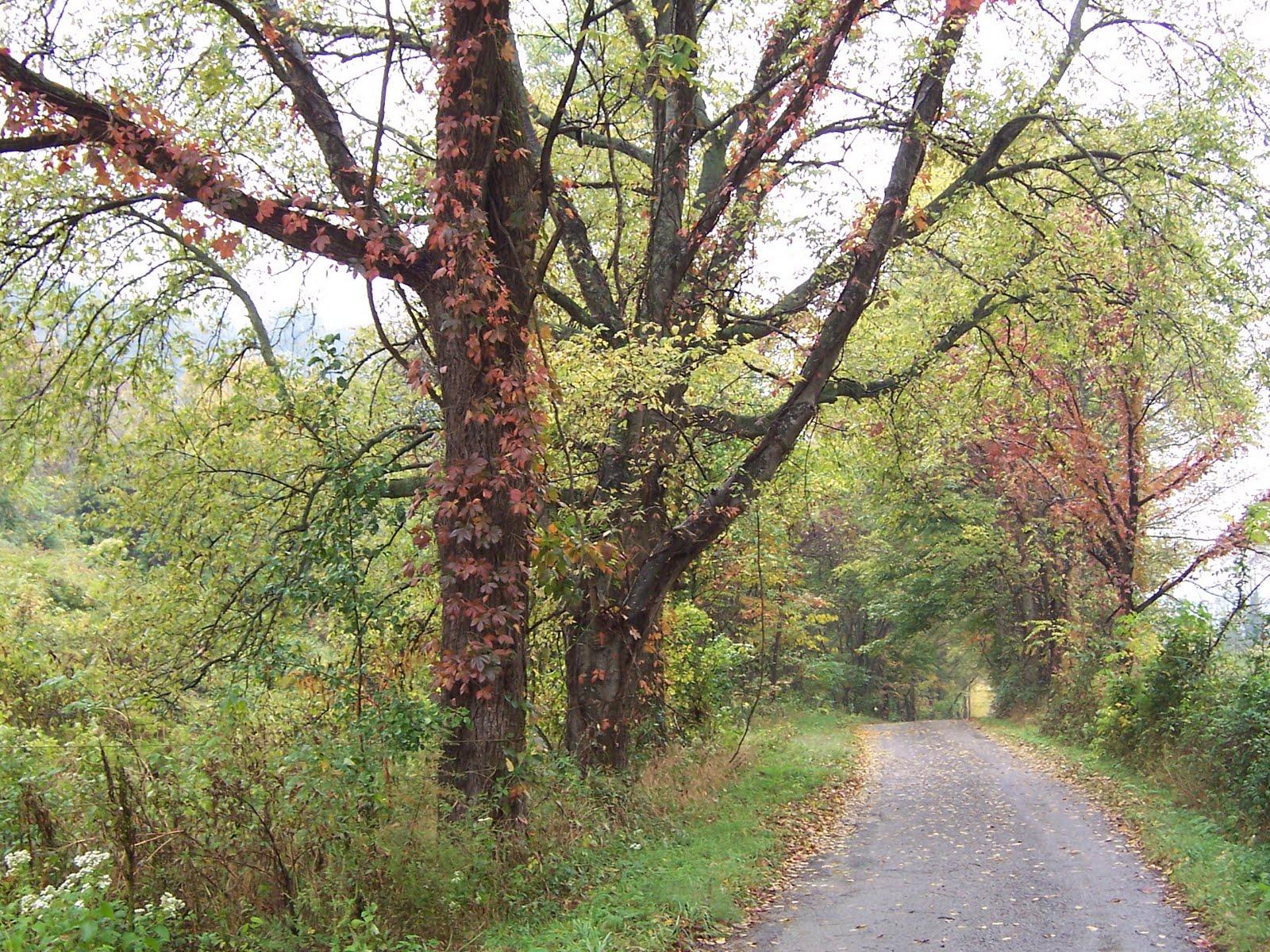
Fall in Fairytale Land on a road with no name

Marie and I went for a drive yesterday to see the fall colors up on Pea Ridge. We came down Adamson Branch and ended up on a road with no street sign. The gravel was loose, and for a minute we considered turning back, considering we were in my very-close-to-the-ground little car. But life favors the bold, and we pressed on, my front end suspension groaning the whole way. We were rewarded with beautiful views and hand patted hamburgers and Chess pie in Gassaway. Another perfect day in paradise.


Now if I could just get the blog posts to publish pictures in the same layout as in the "preview" view...


Sunday, September 25, 2011

Suddenly, it's the end of September and the end of summer

On Friday night I made leek and potato soup with leeks and potatoes from our garden, and I threw in some bacon from Bobby Parker, a local guy who processes his own pigs. He lives near Gassaway, and there are beautiful, huge Tiger lily bushes in front of his house. There are all sorts of metal farming implements beside the driveway leading up to his house. He makes the best fresh sausage I've ever had. When we had our chosen-family reunion this year, I made a vat of sausage gravy and fresh biscuits. There's no kind of fun like making a huge meal with a bunch of friends in the kitchen and feasting with a group of the most wonderful people in the world. All before 9 in the morning.


Briefly, my potato and leek soup recipe: brown bacon in the bottom of your large soup pot. Scoop out bacon, set aside, and lightly fry cubed potatoes (skin on) and white part of chopped leeks in hot bacon fat. Add stock to cover the potatoes and bring to a boil. Simmer until the potatoes are tender, about 10 minutes. Use a potato masher to mash the potatoes, add crumbled bacon, chopped green part of leeks, black pepper, hot paprika, and heavy whipping cream (or half and half or just milk). Bring back to gentle simmer, then turn off the heat and salt to taste.

We suspended the CSA the third week of August and just restarted it this past week. The heat this summer was crazy, and didn't get more than 1/4” of rain at a time for two months. The grass turned brown and crunched under our feet. We didn't equip the garden with irrigation, and we have entirely too much planted for hand watering, even with the hose to do any good. We did try. We planted turnips, carrots, kohlrabi, rutabagas, mustards, lettuce, cucumbers, squash, and beans the first two weeks of August, and we watered every evening only to watch the seedlings pop up and dry out during the passing of another scalding day. Eventually we gave up. Kevin held out longer than I did. At that point, I was kind of avoiding the garden. It looked so sad and droopy. I could almost hear the tomatoes pleading for water. I felt despondent.

I planted hundreds of seeds in flats and set up a makeshift plant baby raising station. We raised some fantastic looking bedding plants. Their vigorous growth kept our spirits up. And hand picking the barrage of leaf-munching caterpillars kept us occupied for long periods of time.

Finally, it rained for three days. It was the perfect rain; gentle and soaking. We got around 5” over those three days, and everything sprung back to life. The trees in the hills that had started to yellow turned green again, and all the blooming weeds towering over the cars on the roadsides and in fallow fields exploded into yellow, purple, white, pink, and red. We rushed out and planted hundreds and hundreds of bedding plants. Lettuce, broccoli, romanesco, mustards, cabbage, and arugula are all now growing like crazy in our beautiful dirt. I couldn't believe how crumbly, dark, and loose our soil has gotten since just this spring. We also replanted our beets, turnips, carrots, radishes, and kohlrabi. Everyone is poking their heads up. It's so nice to see them.

Our CSA has expanded from 4 shares to 13 since May. We have done no marketing. It's all thanks to the newspaper articles and word of mouth. I couldn't believe how understanding our customers were about taking a break. I have no idea how we found such wonderful people to be our customers. Everyone seemed really happy about their first fall share this week, and I felt really good about what we gave them. We're incorporating some produce from other producers right now. There are so many fantastic growers at the market, and they have some vegetables that we weren't able to produce this week. And buying from them using money we earned by selling our own produce helps create a feedback cycle that stimulates the demand for local produce, even if only a little bit. Several people told us how happy they were that we were back at the market yesterday. Customers asked about us while we were gone. A couple of the other growers even told us that they missed us. I almost cried. We couldn't have imagined a warmer community to become a part of.

We left the fallow part of our acre alone (read: I didn't bush hog). I remember sitting in the living room window last year at this time, before there was a window in the rough opening. Where our gray water mulch basin is now, there was a patch of perilla mint in bloom. As it's related to basil, its blooms are exactly like basil's, tall stalks of delicate little purple flowers. I remember almost being able to feel the hum of all the bees going completely crazy in the blooms. I saw my parents' honey bees, carpenter bees, other wild bees, and other pollinators, like different wasps and bugs I can't even identify. So now we have half an acre of perilla in bloom, and you literally can feel the buzzing in the air. I've stood on the edge of the field and seen hundreds of dragonflies dive bombing the tops of the weeds, with song birds flitting back and forth across the field, darting in and out of the trees that border the garden. There are countless bees, rolling around in almost obscene abandon, covering themselves in pollen. It's magical. I thought of sitting in my windowless office, reading in Countryside and in gardening books about leaving wild parts of your farm for the wildlife, a pocket of biodiversity. And now here I am, living in a place that's just exploding with life and diversity.


The mammoth sunflowers we planted this year did grow to be mammoth; they were probably 10' before their huge heads drooped. Now they're a convenient wild bird feeder, away from the barn cats and off the ground. It's a sight to see; the song birds flit from our natural privacy fence, the stretch of 7' tall weeds in bloom along the creek bank, to the drooping sunflower heads. They perch on the top and hang upside to grab a seed and fish out the kernel. The ground is littered with the empty hulls.

I've been taking every opportunity possible to go to the creek during the heat of the day. I just know that our warm days are almost gone for the year. Kevin heard from an old timer that the number of snows in the winter is the same as the number of fogs in August, and it was a foggy August! Some of the locals built a little dam from big rocks and a log, so there is a magnificent swimming hole at Redneck Riveria this year. It encompasses an area where water is gushing up out of the creek bed, at exactly the same temperature it is under the ground, which is cold. The warmer water coming from upstream, heated a little by running shallow over the sun-warmed rocks, mixes with the icy water coming up from the aquifer. You can stand where the warmer water comes spilling over the rocks next to the colder water and feel the two flows mixing together. I take my goggles down there and drift around, caught in the current like so much drift wood, watching the fish pecking at the rocks and the leaves rushing by. Paradise.


On a completely different note, I just finished reading Collapse, by Jared Diamond. I am totally and completely convinced that we are currently living in the beginning of the crumbling of our global society. County lines, country lines, party lines—we are all in this together. I can't stomach what I hear when I do turn on the news. The same paralyzing squabbling here, chaos and suffering out there. “There's coal in those mountains, and as I see it, God put it there for man to take it out.” And we'll all drink the poison that seeps into the murdered streams, that feed the sickened rivers that empty into the despairing ocean, to be lifted back into the sky, cycled through the clouds, and fall back to the ground. Towards the end of the book, Diamond wrote, “Thus, because we are rapidly advancing along this non-sustainable course, the world's environmental problems will become resolved, in one way or another, within the lifetimes of the children and young adults alive today. The only question is whether they will become resolved in pleasant ways of our own choice, or in unpleasant ways not of our choice...”

I feel... so completely grateful to be where I am, doing what I'm doing. This is my pleasant way, of my own choice.

Monday, July 18, 2011

a summer day

This morning I worked for six hours in the garden. I planted some mustard, pruned and tied up tomatoes, picked tomatoes, and forked and weeded. When it finally got too hot to be out in the sun, Kevin and I went to the creek. We took a mask and snorkle and held on to the big rocks where the water rushes through little bottlenecks and watched the bubbles glistening in the sunlight, dappled through the leaves of a big Sycamore. I made a tomato and cucumber salad with basil and the vinegar our CSA customer gave us on Saturday. Where the water swirls around, you can feel the warm and cold water mixing. We had the whole place to ourselves for a couple hours. It was like being at a private resort. I found a great geode. I feel so lucky to have such a wonderful life.

We're starting our second 10-week period this week. I planted more chard yesterday, and the squash I planted late last week is already up. Hopefully the bugs will let us have a few more squash before it will suddenly be frost season again. The tomatoes are going crazy; we sold over 30 lbs of tomatoes at the market on Saturday! We also sold all our greens and a half bushel of cucumbers--all by 11am. The mung beans are up, and soon I have to start thinking about cabbage, broccoli, cauliflower, turnips, rutabagas, radishes, Asain greens, lettuce, more kale...

Back to work!

Wednesday, July 13, 2011

the dog days of summer

I knew I wouldn't be great about keeping up with the blog. I was right. I'm doing better with our Facebook page, though. A picture is worth a thousand words, so they say, and I've been posting lots of pictures.

The Smithville market has been absolutely fantastic. There are some things that don't sell--fingerling potatoes and flowers. But Jason, at Evin's Mill, absolutely loved the fingerlings and wanted more than we have to sell. Everyone seems to love the Technicolor tomatoes and Lemon cucumbers. Delikatesse cucs, not so much. I think they look too much like the cucumbers the other vendors have. We've had several people ask about joining the CSA. We start our second 10-week period next week. So far I'm really glad we split up the growing season into the shorter periods. I'm a little nervous about adding more customers, but I worry all the time and it usually works out, so I'm just going to go for it.

Our Watertown customers make my heart sing. We took my mother to Nona Lisa Pizzeria, owned by Katie and John Smith, our CSA customers, and we enjoyed drop-dead-delicious pizza and a fiddle-accompanied birthday serenade. After that, we caught some world class music at the Blue Tomato, and Mom got another round of the birthday song from everyone in the house. It was great.

As for the garden: the squash are all dead. By next week we will have zero [0] producing squash plants. The vine borers wore us out. Brutal. We're putting in beans and brassicas in the wake of the squash. From my conversations with the other farmers at the market, we are not alone in our losing battle. The tomatoes are starting to pour out of the garden, while some of the cucumbers are beginning to slack off a little bit. Peppers are ripening. Onions and beets are all gone, their beds weeded and mulched, waiting for lettuce and squash to be replanted. The beans are kicking in, despite the Japanese beetles' best attempts. Our pumpkins and winter squash look better than they did a few weeks ago, and they are really starting to grow fast. The Joyners said their blueberries will be in soon. I could never express how excited I am for early mornings in their forest with my mouth stuffed with the best blueberries on the face of the planet.

We've had a heat index over 100 the last couple days, so we've been spending a lot of time at Redneck Riviera.

It turns out all the reading I did has been extremely helpful. However, nothing in any book could ever really prepare you for gardening in Middle Tennessee. This place is nuts.

Everyday I become more convinced that there is no more beautiful place in the world than right here. When I'm driving Glug Glug down Dry Creek and there are puffy white clouds drifting through the blue blue sky past the emerald green of these ancient hills, I can't help but feel like I live in a storybook. The sunflowers look like ladies with big yellow faces wearing green dresses towering over the garden. Queen Anne's Lace is covering all the fallow fields in a lacy white blanket. The Goldenrod and Ironweed are reaching their mature height--7 feet--and will soon be an explosion of yellow and purple. A lot of the rural roads look like paths through the jungle right now.

The garden looked like a jungle until Monday, when a writer from Wilson County came out to interview us about the farm. We were in a tizzy that morning, mowing, weeding, and generally trying to impose some semblance of order over the unruly tangle of green that our garden has become. And then today I got an email from the Watertown Gazette: a second interview request!

Things are going great. We couldn't ask for our first year to be unfolding any better. I am so grateful that this is my life. I love being here. I love farming.

And we still love our lovable loo!