Balsamic Sorghum Vinaigrette
Combine equal parts Balsamic vinegar and sorghum with two parts extra virgin olive oil.
Shake until emulsified and serve.
Serving suggestion: Dress a green salad topped with thinly sliced beets and onions
Red Wine Vinaigrette with rosemary and garlic
Combine one part red wine vinegar with two parts extra virgin olive oil.
Add chopped herbs and garlic, if desired. Shake until emulsified and serve.
Serving suggestion: Toss with chopped tomato, cucumber, and onion. Refrigerate for half an hour before serving to let flavors combine.
Creamy and Sweet Lemon Vinaigrette
Combine equal parts lemon juice and sweetener; shake until sweetener dissolves.
Add equal parts of sour scream or yogurt and extra virgin olive oil.
Shake until thoroughly combined and serve. Keep refrigerated.
Serving Suggestion: Dress a mixed greens salad
Tuesday, July 1, 2014

Friday, May 23, 2014
Travelling with greens and using all those stems
 This week you'll find a sun-tea bag in the shares with three types of mint and red clover. If you like a strong tea, add a couple bags of green or black tea with the contents of the bag to a quart jar and leave it in the direct sun for a couple hours. Use a larger jar for a more dilute flavor. Sweetened with honey, this makes for a delicious and refreshing drink on a hot day.
_______________________________________

Lettuce, lettuce, and more lettuce. Buttercrunch is really putting on a nice show this spring, and the colors are really starting to pop.
__________________________________________
The greens bunches are getting huge. We're eating them in everything, from scrambled eggs to pasta dishes.
I know a lot of you are traveling this summer. If you're wondering how to use the greens in a car-friendly dish, try making a nut butter salad:
Chop the greens up in fine ribbons, like in the Greens Crash Course. In a blender or food processor, combine raw cashews, a liberal amount of curry powder, healthy drizzle of apple cider vinegar (ACV), lemon juice, and some salt and pepper with enough water to form a thick sauce. Add more cumin if you feel like it. Toss with the chopped greens and let everything meld for an hour.
Other combinations to try:
cooked chickpeas, curry, garlic, onion, ACV, healthy oil (nut free)
peanut butter, soy sauce, ginger, honey or sorghum, ACV, healthy oil
These dishes are fine for a few hours without refrigeration. They make great summer potluck salads, in addition to healthy road food.
____________________________________________
 What about all those colorful stems? Don't throw them in the compost bin just yet!
The stems are crunchy and have way more flavor than celery, so you can chop them up and use them anywhere you'd use raw celery:
deviled eggs
tuna, egg, chicken, pasta, potato, etc salad
inside wraps
sprinkled on top of green salads
baked into quiche or a fritatta
delivery vehicle for creamy herb dips
crou d'etat platters

Chopped up stems looks like confetti!
If you like spicy foods, try these Siracha fridge pickles.
Wednesday, May 14, 2014
Lovely Lettuce
While popular and familiar, iceburg
lettuce, by itself, makes for a pallid salad. Unless, of course, it's
a wedge salad with blue cheese and bacon dressing garnished with
sliced green onions and cranberries.

 Another favorite main dish salad at
our farm is a dish that my mother taught me, and her mother taught
her. Buttercrunch is my favorite to use for this salad, but any fresh
lettuce will do. Mix one part honey or sugar with one part lemon
juice. Toss the lettuce with a generous amount of extra virgin olive
oil and some salt. Pour the sweetened lemon juice over the salad and
server with chopped boiled eggs. I have found bacon to be an
excellent addition to this salad, but then there are few things that
don't taste better with bacon! Served with a thick slice of whole
wheat toast, this sweet and savory salad makes for an excellent light
dinner at the end of a hot day spent planting okra and corn.
Another favorite main dish salad at
our farm is a dish that my mother taught me, and her mother taught
her. Buttercrunch is my favorite to use for this salad, but any fresh
lettuce will do. Mix one part honey or sugar with one part lemon
juice. Toss the lettuce with a generous amount of extra virgin olive
oil and some salt. Pour the sweetened lemon juice over the salad and
server with chopped boiled eggs. I have found bacon to be an
excellent addition to this salad, but then there are few things that
don't taste better with bacon! Served with a thick slice of whole
wheat toast, this sweet and savory salad makes for an excellent light
dinner at the end of a hot day spent planting okra and corn.
Romain and butterhead type lettuces
are far more nutritionally dense than iceburg, which is mostly water.
Lettuce leaf stalks have more fiber than the leaves, where vitamins
and minerals are concentrated.
Lettuce stored as a full head
maintains quality longer than if prewashed and cut. Damaged or cut
leaves release an enzyme that causes the degradation of Vitamin C and
discoloration.
If storing cut leaves, dry thoroughly
with a spinner or by gently tumbling in a clean towel. Store wrapped
in a damp paper or dish towel in a sealed plastic bag or container.
The tight, blanched inner leaves of a
head of Romaine or butterhead lettuce make crunchy, delightful scoops
for egg, tuna, and chicken salad or dips like guacamole and chunky
salsa.
We're used to eating salads as a small
primer to the main dish, but fresh lettuce is so delicious and
beautiful, you really can showcase it as a main dinner event.
A giant bed of lettuce can be the base
of a “taco” salad. Pile on browned ground beef seasoned with
cumin and chili powder, cooked brown rice, chopped green onions,
cilantro, and salsa. If you're feeling indulgent, be generous with
the sour cream and cheese; otherwise trying substituting Greek yogurt
for the sour cream. Crumble some tortilla chips on top and dig in!
Another favorite main dish salad at
our farm is a dish that my mother taught me, and her mother taught
her. Buttercrunch is my favorite to use for this salad, but any fresh
lettuce will do. Mix one part honey or sugar with one part lemon
juice. Toss the lettuce with a generous amount of extra virgin olive
oil and some salt. Pour the sweetened lemon juice over the salad and
server with chopped boiled eggs. I have found bacon to be an
excellent addition to this salad, but then there are few things that
don't taste better with bacon! Served with a thick slice of whole
wheat toast, this sweet and savory salad makes for an excellent light
dinner at the end of a hot day spent planting okra and corn.
Make a vegan-friendly, but still robust
and filling, salad by using chickpeas. I highly recommend buying (and
then cooking) dried chickpeas, as they taste much better and have no
added sodium, but canned will do in a pinch. In a blender, combine
half the chickpeas with some water, a lot of curry powder, generous
drizzle of extra virgin olive oil, and fresh or powdered garlic.
Process until smooth. Salt to taste. Toss the rest of the chickpeas
in this curry chickpea dressing and pile the combination onto a
mounded plate of lettuce. A ripe avocado makes a great addition to
the dressing or topping the salad.
Whether you're working to improve or
maintain your health, including salads as a major part of a few meals
per week will help you towards your goal. With a little culinary
creativity, there's no way you'll get bored with green salads before
the spring lettuce bolts and makes way for summer tomatoes.
Friday, March 14, 2014
Spring Color
 For many people, the stars of the
garden are of course the flashy tomatoes, rambling cucumbers,
towering okra, and dazzling spectrum of flowers, but you don't have
to wait until June for color and taste to come pouring out of your
soil.
For many people, the stars of the
garden are of course the flashy tomatoes, rambling cucumbers,
towering okra, and dazzling spectrum of flowers, but you don't have
to wait until June for color and taste to come pouring out of your
soil. Greens are often maligned as boring and bland, perhaps because many people have only ever encountered them out of a can, which is no way to meet any vegetable. The traditional method of cooking a mess of greens is to boil them for hours with pork fat. While sopping up potlickins with homemade cornbread is indeed delightful, greens are very versatile and can be used in a multitude of dishes.
Turnip greens, mustard greens,
cabbage, and kale are the most commonly encountered greens in the
grocery store. Kale has recently been enjoying celebrity status in
foodie culture—with good reason. High in vitamins and minerals,
kale and the other greens can be an important part of maintaining
good health through healthy eating habits.
 Swiss chard, closely related to and
resembling beet greens, has also been featured in many cooking shows
and blogs. The large glossy leaves are tender with a mild flavor. Use
them raw in place of a tortilla in chicken or egg salad wraps. Chard
stalks come in a stunning array of florescent colors. I finely chop
the tender stalks to sprinkle over my deviled eggs or salad like
edible confetti.
Swiss chard, closely related to and
resembling beet greens, has also been featured in many cooking shows
and blogs. The large glossy leaves are tender with a mild flavor. Use
them raw in place of a tortilla in chicken or egg salad wraps. Chard
stalks come in a stunning array of florescent colors. I finely chop
the tender stalks to sprinkle over my deviled eggs or salad like
edible confetti.
Add a nutritional punch to almost any
savory dish by throwing in some chopped greens. From scrambled eggs,
quiche, and fritatta, to chicken, egg, and potato salad, soups, and
stir fry, there is little for dinner or lunch that can't be improved
by adding greens.
Mild greens can be shredded or
julienned and added raw. More pungent greens can be used in small
amounts or cooked lightly to mellow their flavor. A big mess of mixed
greens cooked for 15 minutes in just a little water and coconut oil,
dressed with cider vinegar and a drizzle of honey, seasoned with salt
and pepper, is a fine addition to rice and beans for an easy and
nutritious simple meal.
 Add sensational diversity to your bowl
of lettuce and elevate the salad to a work of culinary art. Combine
curly, frilly leaves that hold a dressing well with leaves that have
a big crunchy stalk. Throw in speckled leaves, purple leaves, dark
green spinach and the blanched chartreuse inner leaves of a head of
romaine lettuce, and you'll forget that you're even working with
“greens”. Top off the salad with slices of a white and pink
'Chioggia' beet and a 'Purple Dragon' carrot, and you'll have a
creation worthy of the finest dining establishments.
Add sensational diversity to your bowl
of lettuce and elevate the salad to a work of culinary art. Combine
curly, frilly leaves that hold a dressing well with leaves that have
a big crunchy stalk. Throw in speckled leaves, purple leaves, dark
green spinach and the blanched chartreuse inner leaves of a head of
romaine lettuce, and you'll forget that you're even working with
“greens”. Top off the salad with slices of a white and pink
'Chioggia' beet and a 'Purple Dragon' carrot, and you'll have a
creation worthy of the finest dining establishments.
Cold hardy and easy to grow, greens
will heartily welcome spring to your garden and can even be grown in
pots on a sunny porch. The kale and arugula I planted last week
germinated in less than 24 hours! Sprinkle seeds over soil you've
prepare for a seed bed and cover lightly with soil. We use
lightweight row cover directly on the soil to speed germination. The
plants will push up the row cover as they grow, and it will afford
some protection from pests.
 About the time the summer bugs start
having their heyday with your greens, the cucumbers, squash, and
tomatoes will be gearing up. Chard and kale left in the ground
through the summer will rebound when fall's cool-off begins, so you
can get two harvest seasons from one planting.
About the time the summer bugs start
having their heyday with your greens, the cucumbers, squash, and
tomatoes will be gearing up. Chard and kale left in the ground
through the summer will rebound when fall's cool-off begins, so you
can get two harvest seasons from one planting.
Wild Garden Seed is a small seed
company that improves and develops varieties for direct-to-consumer
growers, which includes home gardens. Their lettuce varieties 'Joker'
and 'Freedom Mix' are the most stunning lettuces I have encountered.
From 'Purple Peacock Sprouting Broccoli' to 'Scarlet Ohno' turnip,
the color and taste of their varieties are superior to anything
you've ever bought from the grocery store. A few of their varieties
are offered through FedCo Seed Company, as well.
The world of greens is vastly more
expansive than the shelves of Food Lion or Wal-Mart would lead you to
believe. Grown without toxic sprays, harvested fresh, and prepared
lovingly, these leaves can support good health while providing beauty
to be appreciated around the table with family and friends.
Monday, March 3, 2014
Cusp of Spring
These teases of warm weather have
gardeners and bees alike yearning for spring. It's a good time to
reflect on the importance of the present moment. In a few weeks,
we'll all be busy bees with too much to do to waste time wanting for
what is not. Anyway, the daffodils, still hiding their cheerful
yellow faces, are letting us know in no uncertain terms that spring
will be later than it was last year.
 |
| This is actually a Snowberry Clearwing Moth |
While the bees brave this cool weather
to forage on blushing red maple buds and tiny purple henbit flowers,
gardeners and farmers are powerless against the urge to awaken tender
plants from their slumber, nestled inside lifeless-looking seeds.
Some need soaking, some require scoring; others can just be scattered
on the soil surface and lightly misted. Some will burst through the
testa (seed coat) after only a day, whereas others will dally for
weeks—which seems endless.

Once the tiny plants start their
journey toward the sun, they need tender, loving care. In a
greenhouse or on your window sill, they must have bright light or
they will be become lanky and weak, to ultimately flop over and
shrivel. But don't let them get too warm or you risk the soil getting
too hot and scorching their tender roots. The growing medium must
retain adequate moisture, but don't over-water, which can cause
damping-off, lanky growth, and mildew.
Seedlings from seeds sown directly in
the garden must fend for themselves from the beginning. Some
lightweight row cover can help them along, but if you cover with
plastic, be sure to remove it on sunny days—even cold sunny
days—otherwise the plants will bake.
Carrots, beets, and other hardy
Viridiplantae babies seem to appreciate row cover directly on the
soil after sowing. The thin air space between the soil surface and
row cover creates a high-humidity buffer that is a little warmer than
the air temperature, preventing soil crusting and encouraging strong
germination. The plants will push the row cover up as they grow, and
the row cover can provide protection from pests looking for a spring
feast.
 Intrepid growers already have some
seed potatoes and onion sets out. Some just couldn't resist seeding a
round of root crops and hardy greens, like arugula, lettuce, and
kale. Many are chomping at the bit to start tomatoes. I'm holding off
for another week or so. I definitely heard thunder in February,
which, I've been told, means frost in May. I don't want to end up
with giant, leggy tomato plants by the end of April, a situation
which contributed to a lack-luster tomato harvest on our farm last
year.
Intrepid growers already have some
seed potatoes and onion sets out. Some just couldn't resist seeding a
round of root crops and hardy greens, like arugula, lettuce, and
kale. Many are chomping at the bit to start tomatoes. I'm holding off
for another week or so. I definitely heard thunder in February,
which, I've been told, means frost in May. I don't want to end up
with giant, leggy tomato plants by the end of April, a situation
which contributed to a lack-luster tomato harvest on our farm last
year.
If you haven't turned your soil yet,
or even bought your seeds, fret not. You have ample time.
 Southern Exposure Seed Exchange is an
independent seed company offering many unique varieties specifically
suited to growing in the humid heat of Southern summers. 'Louisiana
Purple Pod' pole beans are a favorite of mine—productive whether
it's hot and dry or comparatively cool and wet, always a stunning
purple with great crunch and sweet taste. This variety is also
open-pollinated, so it's easy to save your own seeds. Just let some
pods dry on the vine, harvest, clean, and store in a cool, dark, dry
place.
Southern Exposure Seed Exchange is an
independent seed company offering many unique varieties specifically
suited to growing in the humid heat of Southern summers. 'Louisiana
Purple Pod' pole beans are a favorite of mine—productive whether
it's hot and dry or comparatively cool and wet, always a stunning
purple with great crunch and sweet taste. This variety is also
open-pollinated, so it's easy to save your own seeds. Just let some
pods dry on the vine, harvest, clean, and store in a cool, dark, dry
place.
FedCo is another fantastic source for
GM-free seed. With low prices and a staggering inventory, they offer
something for everyone. As a cooperative, they offer seeds from many
independent producers, constantly working to improve their varieties
and to create new varieties specifically for the home garden and
direct-to-consumer growers. A huge proportion of our yearly seed
order comes from FedCo.

For my tomato-obsessed compatriots,
Baker Creek Heirloom Seeds Company has no comparison. With literally
hundreds of open-pollinated and heirloom tomato varieties of every
color, shape, and taste to peruse, you'll have a hard time putting
down their eye-popping catalog. They also offer a large selection of
unique vegetables, collected from around the world.
The cusp of spring is a time tinged
with reflection, yearning, grand optimism, and colorful seed
catalogs. Surely, this will be a year with just enough, but not too
much rain, no vine borers or imported cabbage worms, immaculate
weedless rows, and no trace of early blight.
Friday, May 31, 2013
Week 4 CSA
Expect greens, greens, and more greens. And the last of the garlic scapes!
 If you're like us, you've got more jars of jellies in your pantry than you know what to do with. Try combining the jelly with peanut butter (or cashew or almond butter), add a little water to loosen, apple cider vinegar and lemon to taste, add a couple good squirts of Bragg's amino acids, and a healthy drizzle of extra virgin olive oil in your blender and process it until it's smooth. It makes for a sweet, creamy dressing that will impress your friends and use up those homemade jellies!
You'll also be receiving a head of cabbage from Eddie Ray in Smithville. They're organically grown and a great size for a small family or couple. If you'd like to make kraut, let us know, and we'd be happy to provide you with beautiful cabbage from our farmer friends.

 If you're like us, you've got more jars of jellies in your pantry than you know what to do with. Try combining the jelly with peanut butter (or cashew or almond butter), add a little water to loosen, apple cider vinegar and lemon to taste, add a couple good squirts of Bragg's amino acids, and a healthy drizzle of extra virgin olive oil in your blender and process it until it's smooth. It makes for a sweet, creamy dressing that will impress your friends and use up those homemade jellies!
You'll also be receiving a head of cabbage from Eddie Ray in Smithville. They're organically grown and a great size for a small family or couple. If you'd like to make kraut, let us know, and we'd be happy to provide you with beautiful cabbage from our farmer friends.

The season's first cabbages marks kraut
making time! Homemade sauerkraut is nothing like the mushy stuff in a
can from the store. Store-bought kraut has been heated to make it
shelf stable, which completely destroys all the health benefits of
this fermented food.
Fermentation, which makes nutrients
easier to absorb during digestion, occurs when sugars in food are
broken down, resulting in lactic acid, which lowers the pH (raising
the acidity) of food below the growth range of dangerous bacteria,
preserving the food and all its nutrients without refrigeration.
Lactic fermented foods add good
bacteria to your stomach. An entire ecosystem of bacteria inside each
of us is responsible for actually breaking down food we eat into
forms that can be absorbed by our bodies.
Fermented foods help balance your
body's pH. The good bacteria absolutely vital for digestive health
cannot thrive in an acidified environment. A standard Westernized
diet high in animal proteins, processed fats, and sugars leaves our
bodies chronically acidified.
Fermentation can be carried out on
your kitchen counter. All it requires is finely shredding your
cabbage or other vegetables and packing them down with salt in a
ceramic or glass vessel to release the juices, which mix with the
salt to create a brine that covers the vegetables. Cover and let the
vessel sit a few days to a few months, until it acquires the flavor
you desire.
Properly prepared, fermented foods are
as delicious as they are nutritious. Local author, Sandor Katz, is
internationally known for his fermentation skills and knowledge. His
book, Wild Fermentation: the flavor, nutrition, and craft of live-culture food, is
a great introduction to fermentation. It's available at the Liberty Library in the old high school building in Liberty.
Friday, May 24, 2013
Week 3 shares

Salads, salads, and stir-fry! TWO heads of lettuce, in addition to the last of the Asian greens, some very spicy mustards bunched with the season's last watercress, leeks, onions, carrots, and GARLIC SCAPES! These succulent treats will probably only be around for another share or two, so be sure to get creative and savor them!

There are lots of recipes available online suggesting creative uses for scapes.
Here's one for Northern Bean and Garlic Scape Dip (and the website I lifted the picture from)
Garlic Scape Pesto
And a collection of recipes
________________________________________

Today we have a couple gluten-intolerant Wwoofers over, so I made a big bowl of egg salad and served it on top of the "farmer food" lettuce... which is what we call the stuff that's too ugly to put in your shares! It still makes a beautiful salad.
Don't forget to use the ribs from you greens to add a fun crunch to stuff like egg salad.
________________________________________

When in doubt, chop it up, throw it in a pan with some rice, try some seasonings like soy, ginger, and garlic or cumin, coriander, and a little curry powder, and you've got yourself a quick, healthy, flavorful meal. Experiment with adding exotic ingredients like coconut milk simmered with lemongrass to keep it exciting!
________________________________________

You'll find a variety of little edible flowers and herbs. The light purple poofs of small flowers are chive blossoms, the yellow are kale flowers, white flowers are arugula, and the dark purple is sage. Sprinkle them over a big pile of lettuce for a salad prettier than a picture!
Friday, May 17, 2013
Week 2 Shares
You'll find the same mix of fresh produce as last week, with the addition of some other goodies, like baby carrots and hardneck garlic scapes.

You can just chop up those greens, heat up some coconut or extra virgin olive oil, and toss everything in a saute pan. Add some grated or finely chopped fresh ginger, soy sauce, and a little black pepper for a simple, fast dish with lots of flavor. Serve with fast-cooking Basmati rice, quinoa, or pearl couscous to round out the meal and have dinner ready in under 30 minutes! (Take that Rachael Ray!)

One of my favorite things to do with chard is add it to tomato sauce. Add the chopped greens just a few minutes before serving. It pairs very well with the acidity and tang of the tomatoes.
I use chard and kale ribs in place of celery to add crunch in pretty much everything, from deviled eggs to tuna salad.

A favorite go-to fast meal here on the farm is to make a giant salad for dinner. I'll top it with a couple boiled eggs, some chopped bacon, and dress it with a sweet lemon dressing. The dressing isn't terribly healthy; lemon juice to sugar at a 1:1 ration with a healthy drizzle of olive oil. But oh my GOODNESS it's delicious... and I figure if you're having salad for dinner, you can afford to splurge on the dressing. My mother taught me that recipe, and her mother taught her.
Part of the fun of CSA and seasonal eating is thoroughly enjoying produce when it's available. We just straight up refuse to buy lettuce in the store (SO inferior), so when it's not in the garden, we don't eat salads. But when the lettuce looks as beautiful as it does now, we eat it for lunch, snacks, and dinner, and sometimes even breakfast.
Soon enough it'll be 100 degrees and tomato season; the lettuce will have bolted and be bitter. Enjoy these beautiful greens while they're here! Experiment, and you never know when you'll taste your new favorite food!

You can just chop up those greens, heat up some coconut or extra virgin olive oil, and toss everything in a saute pan. Add some grated or finely chopped fresh ginger, soy sauce, and a little black pepper for a simple, fast dish with lots of flavor. Serve with fast-cooking Basmati rice, quinoa, or pearl couscous to round out the meal and have dinner ready in under 30 minutes! (Take that Rachael Ray!)
___________________________________________________

One of my favorite things to do with chard is add it to tomato sauce. Add the chopped greens just a few minutes before serving. It pairs very well with the acidity and tang of the tomatoes.
I use chard and kale ribs in place of celery to add crunch in pretty much everything, from deviled eggs to tuna salad.
___________________________________________________

A favorite go-to fast meal here on the farm is to make a giant salad for dinner. I'll top it with a couple boiled eggs, some chopped bacon, and dress it with a sweet lemon dressing. The dressing isn't terribly healthy; lemon juice to sugar at a 1:1 ration with a healthy drizzle of olive oil. But oh my GOODNESS it's delicious... and I figure if you're having salad for dinner, you can afford to splurge on the dressing. My mother taught me that recipe, and her mother taught her.
Part of the fun of CSA and seasonal eating is thoroughly enjoying produce when it's available. We just straight up refuse to buy lettuce in the store (SO inferior), so when it's not in the garden, we don't eat salads. But when the lettuce looks as beautiful as it does now, we eat it for lunch, snacks, and dinner, and sometimes even breakfast.
Soon enough it'll be 100 degrees and tomato season; the lettuce will have bolted and be bitter. Enjoy these beautiful greens while they're here! Experiment, and you never know when you'll taste your new favorite food!
Friday, May 10, 2013
1st Week Share


If you're not sure how to use all those greens, you can always just chop them up and toss them with your lettuce to make a robust, colorful salad. Or add them to a stirfry with the garlic scapes and onions, then season with ginger, a little honey, and some soy sauce.
One of CSA members asked us, "Where are all the holes in your greens?!" Well, you'll find them aplenty in the Asian greens.
 Here are some links about how to use fresh herbs: Oregano and Thyme, Mint, and this Guide to Fresh Herbs. Included this week are oregano, thyme, and a chive blossoms. Just sprinkle the blossoms over your fresh salads. They have a mildly sweet flavor followed by that familiar chive pungency.
Try putting a sprig of mint in your water glass for a light, refreshing flavor. By far though, my favorite way to use mint is in mojitos...
For more ideas and recipes, visit our Greens Guide. Experiment and enjoy!
Thursday, July 12, 2012
Scallop squash and fresh tomatoes

A veritable
rainbow of fresh produce is available at the DeKalb Farmers' Market,
located in the pavilion behind Ace Hardware in Smithville. You can
find all kinds of squash, zucchini, and cucumbers, including some
unique varieties like striped zucchini, patty pan squash, and white
cucumbers. Green bell peppers are in, as are some hotter varieties.
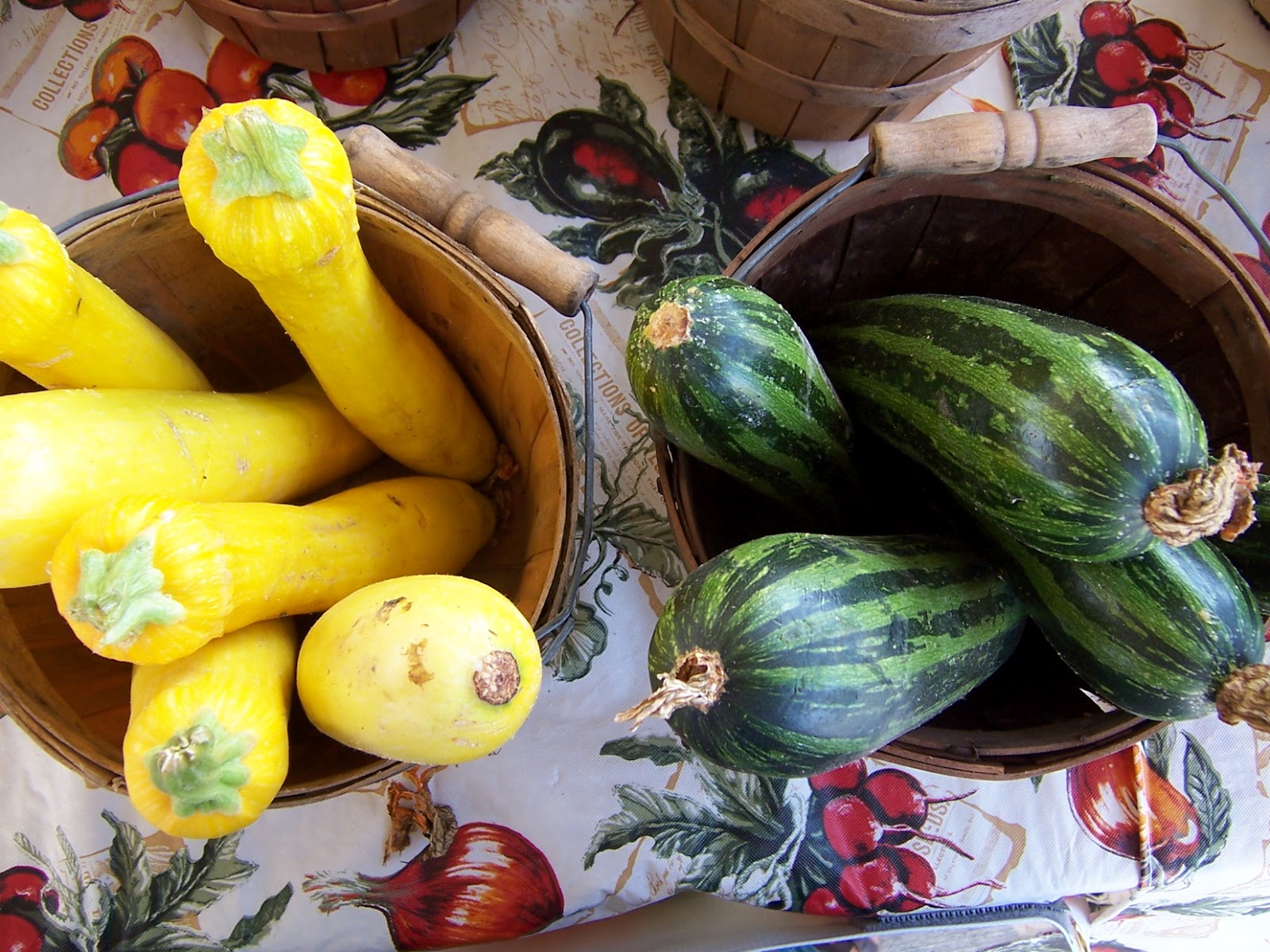
The first beautiful ripe tomatoes are trickling off the vines. You
should never pass up an opportunity to try out a new variety, like
big purple tomatoes or little yellow tomatoes, and opportunities
abound right now. Beans and corn have been in abundance, but this
rain may have come too late for some farmers' crops. If you want to
put up fresh produce this year, be sure you get what's in season
while it's available.
Baked goods, mouth-smacking barbecue,
canned goods, locally roasted coffee, and luscious handmade soaps and
lotions are always available. Flower arrangements, dried and fresh
herbs, and some flower and herb plants are there to tickle your
olfactory and culinary delights.
One of the unique vegetables you'll
find at the market is a scallop squash, also known as a patty pan.
These squash are the shape of a flying saucer and are delicious and
tender even at a larger size. Try out this recipe with a locally
grown creamy white patty pan.
Grate up the squash using either a box
grater or your food processor. Place the grated squash in a
colander, sprinkle with salt, and set aside to drain for a few
minutes. Melt a couple tablespoons of butter and sauté a handful of
coarsely chopped onion just until translucent, about 2 minutes. Toss
1 tablespoon of flour with the butter and onions, and cook until the
flour turns golden brown. Stir in a couple tablespoons of half and
half to form a paste. Add the squash and cook, stirring constantly
5-7 minutes, until the excess moisture has been released to form a
creamy mixture. Stir in a couple tablespoons of sour cream and
season to taste with white vinegar, salt, and pepper. Mix in freshly
chopped dill or basil, and let chill for at least 15 minutes before
serving. You could lighten up this recipe by using milk instead of
half and half and substituting Greek yogurt for the sour cream. The
original version of this recipe can be found here: “Hungarian-Sytle Summer Squashwith Dill Recipe.”
Patty pans come in many colors, from
sunny yellow, to pale green, creamy white, green stripes on white,
light yellow stripes on mustard yellow, and even dark hunter green.
You can pick them when the squash are so young their flowers are
still attached and intact or let them get as big as a dinner plate.
Some varieties of patty pan squash can even be harvested as winter
squash.
The plants that produce these squash
can get enormous. We have one that's almost 6 feet long! They seem
less susceptible to annihilation by stink bugs and squash bugs, but
our patty pans definitely succumb to the vine borers last year.
I've heard that if you notice the
tell-tale wilting of a vine borer in action early enough that you can
cut out and destroy the offending larvae, then mound up dirt or
compost around the base of the plant, and sometimes successfully save
your squash plant.
Some growers swear by putting aluminum
foil around the base of the plant while it's young, or wrapping the
stem with panty hose to keep the bugs from boring in. We tried
putting a liberal dusting of diatomaceous earth (DE) around the
plants and on their stems early this season.
If you haven't planted squash yet,
it's not too late. Now is the perfect time since it's rained a
little, and there's more rain in the forecast. Squash love rich
soil, so add some compost and plant a squash seed. When the soil is
warm and moist, it's not unusual for them to germinate in a day.
Another of the summer's delights, the
homegrown tomato, is finally ripe. An out-of-season grocery store
tomato and a freshly picked, vine-ripened tomato are as different as
Earth is from Venus. There is nothing more triumphant to a gardener
or farmer than that first perfect tomato, still warm from the sun,
eaten right there in the garden without a knife or a napkin.
Roma and paste type tomatoes are great
for making sauce, paste, and salsa since they have fewer seeds and a
denser flesh. The smaller grape and cherry type tomatoes make an
awesome raw snack. Just rinse and pop in your mouth! Try including
the small tomatoes on your kebabs and roast them on the grill.
Slow cooked and painstakingly prepared
spaghetti sauce is a fantastic comfort food in colder weather, but
after a long day in the garden, I prefer to just throw together a
fresh sauce. I'll use any tomato I have, whether it's purple,
yellow, red, or striped; chop the tomato into big chunks. Heat up
some extra virgin olive oil, sauté a chopped onion for a minute, add
a couple cloves of minced garlic and cook for 1 minute more. Dump in
the chopped the tomatoes, add whatever herbs you have on hand, and
simmer for just a few minutes. I always use basil, but oregano,
thyme, chives, rosemary, and savory would all make great
substitutions or additions.
If you really want to can your
tomatoes, but they're trickling in slowly, you could freeze your
daily harvest and save up until you have enough to make it worth the
hassle. You can freeze them whole or cut them into big chunks. Lay
the pieces flat on a baking sheet until frozen solid then store in a
freezer bag.

A gourmet way to feature your favorite
tomato is to make a caprese salad. Get a hunk of good mozzarella
cheese—the kind that comes in a little bag with water. Slice the
cheese and tomato into ½ inch thick slices. Arrange together on a
plate, garnish with a generous amount of basil, and drizzle with a
good quality olive oil. Take this simple dish to another level by
using an usually colored tomato and a mix of purple and green basil.
If your basil gets away from you and starts blooming, you can use the
flowers to add a floral flourish to your food.
Of course, one of the best ways to
enjoy a ripe tomato is in the classic tomato and mayo sandwich. To
make your inner-foodie squeal, use fresh baked oatmeal bread and
homemade mayonnaise!
Blackberries, a brilliant summer delight

Part of the fun of seasonal eating is
enjoying what's available in as many different ways as possible.
There is little else as glorious as a sun ripened blackberry fresh
off the cane, but if you know a good picking spot or happen upon a
gallon at the market, there are numerous fantastic ways you can
include fresh blackberries in your diet.
One of the most familiar and most
delicious is blackberry cobbler. There are almost as many blackberry
cobbler recipes as there are blackberry canes in an abandoned hay
field, but here's a very easy, very basic one. Melt ½ cup (1 stick)
butter in a 2 quart casserole dish by placing in the oven as you
preheat to 350. Combine 1 cup flour, 1 cup sugar, 1 tablespoon
baking powder, 1/8 teaspoon salt, and 2/3 cup milk and mix well.
Toss 2 ½ to 3 cups of fresh or frozen blackberries with 1-2
tablespoons of sugar. Pour batter into melted better; do not stir.
Spoon blackberries over the batter, but don't stir. Bake for 45
minutes or until golden brown. I like to add sorghum to my berries,
and I add a little vanilla, cinnamon, and nutmeg to the batter when I
make cobbler.
Try making your own whipping cream to
top the cobbler. Use an electric mixer to whip some heavy whipping
cream until it starts to make peaks. Add a teaspoon of confectioners
sugar and a dash of vanilla, then whip until it's a little stiffer.
Be sure the cream is cold. Some people even recommend refrigerating
your bowl and beaters, but I've never taken those extra steps. It's
so easy to make, and so much better than the canned whipped cream!
You can also make a fantastic salad
dressing from fresh or frozen blackberries. Muddle (mash) a couple
tablespoons of berries, combine with a teaspoon of honey, a couple
tablespoons of white wine vinegar, and a quarter cup of extra virgin
olive oil. You can dress up a simple green salad, or even try this
dressing over warm sautéed greens.
Light meats like pork, chicken, and
white fish pair beautifully with the tart, bright flavor of a
blackberry marinade. Starting with the same base as the salad
dressing, muddled berries, honey, and white wine vinegar, add spices
like cumin, black pepper, salt, and just a dash of cinnamon. Or you
could try leaving out the cumin and cinnamon and add fresh herbs,
like basil and thyme instead. Spoon over the meat and marinate for a
couple hours before cooking. Make extra marinade to serve on the
cooked meat.

Another way to enjoy blackberries is
to make a refreshing magenta blackberry punch. Using a spoon, clean
the skin off a 1” chunk of fresh ginger. Combine ginger, 1 ½ to 2
cups blackberries, one cup sugar, and ¾ cup lemon juice in a
blender. Process until well blended. Pour mixture into pitcher and
combine with water at a ratio of 1:3, mixture to water. You can add
more or less water depending on your preference.
To make a fizzy
punch, dilute with water instead of ginger ale. Serve with a mint or
basil garnish. Served cold, this punch is a great way to cool down
during a hot summer afternoon. It would be beautiful at a picnic or
wedding. And if imbibing your corn instead of eating it on the cob
is your style, this punch would pair wonderfully with the brews from
Short Mountain Distillery in Woodbury.
Blackberries are part of the group of
plant species that transition open ground back to forest. They pop
up where ground has been disturbed and goes without being mowed for
long periods of time. That's why you'll see them growing along
roadsides and in neglected pastures and hayfields. Blackberries are
perennials; the canes die back each year, but the roots survive the
winter in the ground.
Harvesting blackberries is a fun but
delicate task. I wear long pants, long sleeves, solid shoes, and
long gloves. It's easiest to pick with both hands free.
You can cut
out the front of a milk jug, put your belt or a string through the
handle, and tie it around your waist. It's best for the berries and
most comfortable for the picker to go early in the morning, but you
should go any time you can.
Picking blackberries in the summertime
was an integral part of my summertime growing up in the South. When
the sun is hot and you're surrounded by a blackberry bramble you can
smell the fruit ripening in the afternoon heat. I learned by
experimentation that the bigger, more supple berries are the juiciest
and sweetest. The little ones are more tart but have a very strong
flavor. Those little ones are great for making jellies and jam.
It's extremely easy to freeze
blackberries. Just pick through the berries to get out any little
stems or leaves and arrange in a single layer on a cookie sheet. Put
in the freezer until frozen through, then pour them in a freezer bag.
You can make any of the recipes above with frozen berries. They're
also a great way to pep up a cold winter morning's pancakes or a bowl
of yogurt and granola.
Blackberries are an excellent source
of vitamins C, K, and E, folate, magnesium, potassium, manganese,
copper, and dietary fiber. The intense color of blackberries is due
to their high concentration of anthocyanin antioxidants, which
support your body's immune system. A cup of blackberry and honey tea
sipped the grips of a dreary winter cold can help give your body the
boost it needs to heal itself.
Harvesting wild blackberries is a
great way to get into foraging for wild foods. Blackberries are easy
to spot and positively identify and easy to harvest and process. You
can't pick too many, and it would be hard to trample any patch to the
point of compromising the next year's growth. Foraging reconnects
you with the wild world, of which you are indelibly a part. If
you're looking out for a perfect patch of blackberries on the side of
the road, you notice more of the natural community of plants that
surrounds us, instead of passing it all by in a blur of green as you
dash down the highway.
If you don't have time or can't be
bothered to pick these seasonal beauties for yourself, please
understand why they're rather expensive. Picking the berries without
marring your hands and forearms is an act of grace and rapt
concentration, even with sleeves and gloves. The berries are little,
and while they do grow in dense patches, it's surprising how long it
can take to painstakingly move through a maze of thorny canes as tall
as you are. They don't keep very long, so any berries you buy at the
market haven't been off their canes very long.
The blackberry harvest can be a
challenge, but it's a welcome challenge. I spend February evenings
fantasizing about the sun roasted fruit and fresh cobbler with
whipped cream makes. Those sweet culinary payoffs make all the tick
bites worth it.
Monday, July 9, 2012
Cabbage and Fermented Foods

The beautiful, fresh vegetables are
pouring in right now. You can get cabbage, squash, zucchini,
potatoes, green onions, lettuce, kale, swiss chard, fresh herbs,
cucumbers, and the season's first scrumptious beans. There are
always delicious baked goods, canned goods, handmade soaps and
lotions, barbecue, and dried herbs. It's almost time for corn and
tomatoes. You never know when someone will show up with the first
small harvest of those summer gems. Be sure you don't miss out, and
drop by every week to check what goodies everyone has!
Fantastic heads of local cabbages are
coming out of the fields right now.
Cabbage is a very familiar
vegetable to many people, but that doesn't mean it has to be boring.
You can eat it raw, lightly steamed or sautéed, braised, roasted, in
casseroles, or fermented, but don't boil or microwave it. Boiling,
like with pretty much any other vegetable, boils away many of the
water soluble vitamins and nutrients and leaves your cabbage mushy
and pallid. Microwaving destroys the healthy enzymes that make
cabbage the nutritional powerhouse that it is.
Cabbage contains vitamins K, C, B1 and
B6, folate, fiber, potassium, calcium, and manganese. It has
cholesterol-lowering nutrients, making it great for maintaining heart
health. Cabbage juice is a traditional and effective treatment for
peptic (stomach) ulcers, and including cabbage in your diet is a good
way to help maintain digestive health.
One of my very favorite ways to enjoy
cabbage is to braise it in the oven with either a dark beer or red
wine. You could also stock or even just water as a braising liquid,
but I love the rich flavor from using beer or wine. All of the
alcohol content is destroyed during cooking.
For a medium (2 lb) cabbage, quarter
and core, then halve the quarters, leaving you with eight wedges.
Arrange the quarters in a 9” x 13” baking dish so that they lay
flat, barely touching each other. Scatter carrots chopped into 1/4”
rounds and sliced onions over the cabbage. Drizzle with some olive
oil and pour about a 1/4” of dark beer into the dish. Season with
salt and pepper, cover tightly with foil, and bake for about 2 hours
at 350 until the veggies are tender. If you use a smaller head or
smaller wedges, the cooking time will be reduced.
About half way through, turn the
cabbage wedges. If the liquid is getting low, add more braising
liquid. Once everything is tender, turn the heat up to 400, take off
the foil, and cook for another 15 minutes or just until the
vegetables being to brown. This original recipe can be found at “World's Best Braised Cabbage.”
Sautéing is a quick, easy, healthy
way to cook cabbage. The basic recipe is super easy. Quarter and
core the cabbage, then slice into 1/2” thick ribbons. Heat a
skillet to medium-high heat, add some extra virgin olive oil or
coconut oil, and let the oil heat up. Make sure you use a skillet
large enough that the cabbage lays in the bottom in just a thin
layer. Add the ribboned cabbage and then add about ¼ cup of stock
or water. Cover and cook the cabbage for about 5 minutes. Season
with salt and pepper to taste.
To dress up the simple sauté, you
could add other chopped vegetables, like onions, peppers, or
carrots. For a wholesome, meatless but fulling meal serve the dish
with quinoa (pronounced “keen-wah”), a fantastic whole grain that
cooks quickly and packs a nutritional punch, since it's a perfect
protein. You can add exotic seasonings like cumin and coriander and
pair it with curried potatoes for a delicious Indian-cuisine inspired
dish.
For a more decadent cabbage dish, try
cabbage casserole with bacon and cheese. I usually make this dish
with leftover rice. Combine lightly sautéed ribboned cabbage and
onions, cooked rice, crumbled bacon, and crumbles of a strong
flavored, creamy cheese like Blue cheese or Gorgonzola, with a
sparing sprinkle of salt and a couple liberal rounds with freshly
cracked pepper. Bake at 350 until the cabbage is tender; timing will
depend on the size pan and amount of ingredients stuffed into it.
Once the cabbage is tender, crank the heat up to 400 or 425 and
lightly brown the top of the casserole.
A really fantastic way to augment of
the wide range of nutrients in the whole raw cabbage is to make
saurekraut or kimchi by the process of fermentation. Fermentation
occurs when the sugars in food are broken down, resulting in lactic
acid. The lactic acid lowers the pH (acidity level) of the food
below the growth range of dangerous bacteria, preserving the food and
all its nutrients without refrigeration.
This food preparation and preservation
process can be carried out right in your own kitchen. Essentially
all it takes is finely shredding your cabbage and other vegetables
and packing them with salt in a ceramic or glass vessel and pressing
them to release their juices. The juices mix with the salt to create
a brine which covers the vegetables. You let the vessel sit for a
few days, a few weeks, even a few months, until it acquires as strong
a flavor as you desire.
Lactic fermentation allows many
nutrients to be more easily absorbed during the digestive process.
Foods prepared by lactic fermentation add good bacteria to your
stomach. That ecosystem of bacteria inside each of us is what is
responsible for actually breaking down the food you eat into a form
that can be absorbed by your body. Fermented foods also help balance
your body's pH. The good bacteria absolutely vital for digestive
health cannot thrive in a chronically acidified environment. The
standard Westernized diet high in animal proteins, processed fats,
and sugars leave our bodies chronically acidified.
Both traditional lore and peer
reviewed studies agree that fermented foods are a boon to human
health. Properly prepared, they are as delicious as they are
nutritious. Local author, Sand Katz, is nationally known for his
fermentation skills and knowledge. His book, Wild Fermentation:the flavor, nutrition, and craft of live-culture food
is a great introduction to the world of fermenting foods, and it's
available at the Liberty Library in the old high school building in
Liberty.
Get some fresh,
locally grown cabbage at the market this weekend, and delve into the
culinary craft of creating your own fermented foods!
Squash season

There's nothing like the first summer
squash feast of the season. Those golden, tender slices cooked with
onions. Or made into a creamy casserole with cheese, bread crumbs or
crackers, and a little milk, seasoned with just a little salt and
pepper. The succulent, slightly sweet flesh is so versatile that it
pairs deliciously with many other garden veggies.
A couple plants can keep a family's
table covered in squash every day for weeks. Its versatility is a
major boon, since those sunny yellow squash can really pile up when
the season gets going.
Summer squash is full of many
important nutrients, including B-vitamins, vitamin C, molybdemun,
manganese, and fiber, in addition to being a great source of omega-3
fatty acids, which are lacking in the typical Western diet.
When you're selecting summer squash,
choose squash with unblemished, tender skin. If you get any with
bruises, you should use those first. Unblemished squash will keep in
the fridge for at least a week.
To maintain more the great nutrients
in summer squash, avoid boiling it and be sure to eat the skin. You
can slightly steam, roast, grill, sauté, and even freeze squash and
still maintain all its nutrients.
Skewer baby squash, brush with olive
oil, sprinkle with salt and pepper, and throw them on a hot grill
until tender. Wrap up the whole baby squash or chopped large squash
in an aluminum foil packet, place on the grill away from the direct
heat, and by the time your chicken or hot dogs are done, the squash
will be perfectly cooked. You can also just toss baby squash or
chopped squash with olive oil, sprinkle with salt and pepper, and
roast in the oven at 325 for about twenty minutes. You can add whole
baby onions or thick slices of onion to any of those cooking methods
with delicious effect.
To freeze squash, thickly slice the
bigger fruit or use the little ones whole. Lightly blanch, then
freeze in a single layer on a cookie sheet. After frozen solid,
place them in an airtight bag. When you defrost it, put you can put
it on the grill, sauté, or steam the squash, and it will be almost
as good as it is fresh.
One of our farm's favorite ways to
cook up squash or zucchini is to sauté it with some swiss chard.
Slice up some onions and squash into ¼ inch thick slices. Strip the
chard leaves off the ribs and chop the ribs into inch long sections.
Sauté the onions, squash, and chard ribs for 3-4 minutes in extra
virgin olive oil or coconut oil over medium-high heat. Add the
ripped up chard leaves and cook for another 4-5 minutes. Season with
sea salt and fresh pepper and a dash of white whine vinegar. The
color combination of this dish is out of this world.
Sauteed squash with chard makes a great side dish that's
packed with vitamins and minerals. In addition to an array of
phytonutrients and antioxidants,
both squash and chard are rich in fiber, which helps regulate the
speed at which carbohydrates are converted to simple sugars during
the digestive process. Regulating that process minimizes blood sugar
spikes. Maximizing your consumption of fresh produce is a great way
to help manage diabetes.
You can turn your sautéed squash,
onions, and chard into a meatless main course dish by combining it
with a whole wheat chunky pasta or tortellinis. The combination of
the vegetables and pasta provide you with plenty of protein for a
complete meal, but the flavors go great with a meat addition, too.
 |
| image from www.crumblycookie.net |
Another creative way to use squash and
zucchini is to grate the whole thing, skin on, and use it as a
beautiful, edible garnish. You can serve it over a great green
salad, or feature the grated squash and zucchini as its own salad.
Dress the grated flesh with some a red wine vinaigrette. To make the
vinaigrette, combine red wine vinegar and extra virgin olive oil at a
1 to 3 ratio and season with a touch of salt and pepper. Toss with
some freshly chopped basil, mint, or oregano for a gourmet touch.
Eating healthy and fresh is easy when
there's so much great produce around. Be sure to check out the
market this week and load up on healthy, beautiful food for your
family!
Wednesday, June 6, 2012
More chard, our beautiful lettuce, and salad dressings

If you haven't dropped by the farmers'
market, located in Smithville behind Ace Hardware, this is the
perfect weekend to come on down. We've got two vendors selling fresh
produce, so you can get the season's first lettuce, cabbage, kale,
chard, and spring onions. The early birds got the eggs and fried
pies; they go quick. There are all kinds of baked goods, canned
goods, handmade soaps and lotions, vegetable and herb plants, fresh
and dried herbs, and the best barbecue, hot wings, and smoked meats
you've ever put in your mouth.
Saturday, June 9th we'll really kick
off the produce season with a “grand re-opening”, but there's
plenty of good stuff to be had right now!
The fresh produce season starts off
with a profusion of greens. I've encountered more people than I can
count who have been turned off eating greens by a run-in with mushy,
bitter greens. I can't emphasize enough that properly prepared
greens are never mushy, never
tough, and not bitter.
One of the leafy
greens that's in season right now is Swiss chard. Swiss chard looks
almost identical to beet greens because it's in the same family as
beets. Chard leaves are rich in phytonutrients, which provide
antioxidants with powerful anti-inflammatory benefits. One cup of
cooked chard will supply you with more than your recommended daily
allowance of vitamins K and A, in addition to a slough of other
vitamins and minerals, including vitamins C, E, and B vitamins, and
minerals including calcium, potassium, magnesium, manganese, iron,
fiber, and protein. Believe it or not, that list isn't complete, but
it serves to demonstrate what a nutrient-dense food chard is.
Since chard is
rich in protein and fiber, it is an excellent addition to your diet
if you're managing diabetes. Protein and fiber help regulate the
speed at which carbohydrates are converted to simple sugars during
the digestive process, which minimizes blood sugar spikes.
Fresh chard isn't
tough; you can use both the leaves and the ribs. I am absolutely in
love with the bright colored ribs produced by the Bright Lights chard
we grow at our farm. The variety of colors of the ribs represents a
variety of phytonutrients, so including as many colors on your plate
as possible ensures a wide variety of nutritional benefits!
You can use chard
raw to dress your green salads, but people with a sensitivity to
oxalic acid should eat their chard cooked. Quickly boil the chard,
but only for 3 minutes. Pour off the water and season with a touch
of salt and pepper and a dash of your favorite vinegar. You can also
lightly sauté a bunch of chopped chard in some heated olive or
coconut oil and season it the same way. It only needs to be sautéed
for 5-7 minutes over medium-high heat. The color should still be
green when it's done cooking—never, never brown! Sautéed chard is
a great side dish served with pork chops, steak, chicken breasts,
fish fillets, or tempeh or tofu.
Chard pairs
remarkably well with tomato sauce, so when it's in season, I almost
never make spaghetti without chard leaves in the sauce. I chop up
the ribs and sauté them with the onions and garlic that start off my
spaghetti sauce. About five minutes before the sauce is ready to
eat, I throw in the uncooked, chopped chard leaves with a handful of
fresh herbs. After just a few minutes of lightly simmering, the
leaves are still bright green, and the herbs have infused the sauce.
As an aside—did you know that six leaves of oregano have the same
antioxidant content as an entire apple?
Another fantastic
fresh green available right now is kale. If the only kale you've
ever eaten was out of a can or that pre-chopped abomination in the
grocery store, I implore you to give it one more try.
Kale is a
nutritional powerhouse. It contains vitamins K, A, and C, manganese,
and fiber, in addition to having antioxidants and anti-inflammatory
properties. Its nutritional profile also includes high
concentrations of carotenoids and flavonoids which have powerful
cancer preventative properties.
Any of the recipes
listed above for chard work just as well for kale. In fact, kale and
chard mixed together make an excellent combination. However, my very
favorite way to enjoy kale is by eating an entire cookie sheet worth
of baked kale chips.
Baking kale chips is the ultimate
route to winning over new kale eaters. No kidding, it's as easy as
this: Lightly toss the washed and dried leaves with a little olive
oil. They shouldn't be drenched, just lightly dressed. Arrange the
leaves in a single layer on a cookie sheet and season with a very
small amount of sea salt and pepper; add some garlic powder if you're
into that. If you're feeling fancy, sprinkle on a little freshly
grated Parmesan cheese. Bake in a preheated 350º
oven for 7-12 minutes, depending on your oven. You want the leaves
crispy and dried but only barely browned. Before trying it, you
can't conceive of how delicious this easy recipe really is.

Fresh salads are
another delight of the spring season. Lettuce can shake off a light
frost, and some varieties will hold out through some hot weather, but
by the time the tomatoes are rolling in, the lettuce will be gone.
Iceburg lettuce is popular and familiar, but the world of lettuce is
vastly more exciting and aesthetically pleasing than those ubiquitous
light green heads. You can grow varieties that are lime green with
splashy red speckles, some with frilly, curled leaves, heads that
grow a foot and a half tall, intense red frilly leaves, loose-head
buttercrunch varieties with soft red speckles, iceburg style heads
with pink speckles; the list goes on and on and on.
We've all tried
the usual ranch, honey mustard, and French style dressings, but you
shouldn't limit yourself to such a finite palate. Fresh dressings
are infinitely variable and extremely easy to make. I usually make
them in a canning jar so I can put a lid on and shake to emulsify
(combine) the ingredients and store the leftover dressing in the
fridge.
Here are a few of
our farm's favorite dressings:
For a simple
vinaigrette dressing use a 1 to 3 ratio of vinegar to oil. Combine
red wine, balsamic, or white wine vinegar with extra virgin olive
oil. Add a dash of salt and pepper and maybe some dried herbs.
Shake until emulsified and eat up! You can add freshly chopped
garlic or garlic powder, use freshly chopped herbs instead of dried
herbs, or try out grapeseed or sunflower oil instead of olive oil.
You can't mess it up, so just experiment until you find a flavor
combination that knocks your socks off. This style of simple
vinaigrette goes great with a salad that's dressed up with feta
cheese, green onions, and chopped kalamata or black olives.
To give your salad
a more gourmet, exotic twist, try a ginger, peanut butter dressing.
I know this combination of ingredients will sound a little strange,
but I absolutely guarantee it'll blow you away. Combine about a
tablespoon of peanut butter (the creamy, natural kind works best, but
I've been known to make this with the regular crunchy kind, too), a
teaspoon of soy sauce or Bragg's amino acids, a plop of honey, a half
inch chunk of fresh ginger, grated, a dash of black pepper, a couple
tablespoons of white wine or apple cider vinegar, and about a ¼ cup
of olive oil. Shake, shake, shake until all the ingredients have
combined, and give it a taste. Depending on your palate, you might
want a little more tang, so add some more vinegar, or maybe a little
sweeter, so add some more honey. I usually end up adding twice as
much ginger because I just can't get enough of it. The recipe is
just a guideline; play with it to suit your taste. We love this
dressing so much, sometimes I'll make an enormous salad just as an
excuse to make this dressing.
Since you've got
ginger leftover from trying the peanut butter dressing, the next
night you can try out a lemonade ginger dressing. Combine equal
parts sugar and lemon juice, add as much freshly grated ginger as you
want, a dash of salt to bring out the flavor, and top off with extra
virgin olive oil at the same 1 to 3 ratio, using the lemon juice
instead of vinegar. This sweet and tangy dressing pairs phenomenally
well with a salad that's jazzed up with some chopped fruit, like
apples, strawberries, or peaches.
Just because most
of the fresh produce right now is green doesn't mean it has to be
boring or bland. Part of the joy of seasonal eating is enjoying the
changing palate throughout the year and becoming a more robust and
creative cook. Experimentation is fun. There's literally no end to
the number of dishes you can create utilizing fresh greens!
Wednesday, May 30, 2012
Some delights of spring: chard, kale, and lettuce
If you haven't dropped by the farmers'
market, located in Smithville behind Ace Hardware, this is the
perfect weekend to come on down. We've got two vendors selling fresh
produce, so you can get the season's first lettuce, cabbage, kale,
chard, and spring onions. The early birds got the eggs and fried
pies; they go quick. There are all kinds of baked goods, canned
goods, handmade soaps and lotions, vegetable and herb plants, fresh
and dried herbs, and the best barbecue, hot wings, and smoked meats
you've ever put in your mouth.
Saturday, June 9th we'll really kick
off the produce season with a “grand re-opening”, but there's
plenty of good stuff to be had right now!
The fresh produce season starts off
with a profusion of greens. I've encountered more people than I can
count who have been turned off eating greens by a run-in with mushy,
bitter greens. I can't emphasize enough that properly prepared
greens are never mushy, never
tough, and not bitter.
 One of the leafy
greens that's in season right now is Swiss chard. Swiss chard looks
almost identical to beet greens because it's in the same family as
beets. Chard leaves are rich in phytonutrients, which provide
antioxidants with powerful anti-inflammatory benefits. One cup of
cooked chard will supply you with more than your recommended daily
allowance of vitamins K and A, in addition to a slough of other
vitamins and minerals, including vitamins C, E, and B vitamins, and
minerals including calcium, potassium, magnesium, manganese, iron,
fiber, and protein. Believe it or not, that list isn't complete, but
it serves to demonstrate what a nutrient-dense food chard is.
One of the leafy
greens that's in season right now is Swiss chard. Swiss chard looks
almost identical to beet greens because it's in the same family as
beets. Chard leaves are rich in phytonutrients, which provide
antioxidants with powerful anti-inflammatory benefits. One cup of
cooked chard will supply you with more than your recommended daily
allowance of vitamins K and A, in addition to a slough of other
vitamins and minerals, including vitamins C, E, and B vitamins, and
minerals including calcium, potassium, magnesium, manganese, iron,
fiber, and protein. Believe it or not, that list isn't complete, but
it serves to demonstrate what a nutrient-dense food chard is.
Since chard is
rich in protein and fiber, it is an excellent addition to your diet
if you're managing diabetes. Protein and fiber help regulate the
speed at which carbohydrates are converted to simple sugars during
the digestive process, which minimizes blood sugar spikes.
Fresh chard isn't
tough; you can use both the leaves and the ribs. I am absolutely in
love with the bright colored ribs produced by the Bright Lights chard
we grow at our farm. The variety of colors of the ribs represents a
variety of phytonutrients, so including as many colors on your plate
as possible ensures a wide variety of nutritional benefits!
You can use chard
raw to dress your green salads, but people with a sensitivity to
oxalic acid should eat their chard cooked. Quickly boil the chard,
but only for 3 minutes. Pour off the water and season with a touch
of salt and pepper and a dash of your favorite vinegar. You can also
lightly sauté a bunch of chopped chard in some heated olive or
coconut oil and season it the same way. It only needs to be sautéed
for 5-7 minutes over medium-high heat. The color should still be
green when it's done cooking—never, never brown! Sautéed chard is
a great side dish served with pork chops, steak, chicken breasts,
fish fillets, or tempeh or tofu.
Chard pairs
remarkably well with tomato sauce, so when it's in season, I almost
never make spaghetti without chard leaves in the sauce. I chop up
the ribs and sauté them with the onions and garlic that start off my
spaghetti sauce. About five minutes before the sauce is ready to
eat, I throw in the uncooked, chopped chard leaves with a handful of
fresh herbs. After just a few minutes of lightly simmering, the
leaves are still bright green, and the herbs have infused the sauce.
As an aside—did you know that six leaves of oregano have the same
antioxidant content as an entire apple?
Another fantastic
fresh green available right now is kale. If the only kale you've
ever eaten was out of a can or that pre-chopped abomination in the
grocery store, I implore you to give it one more try.
Kale is a
nutritional powerhouse. It contains vitamins K, A, and C, manganese,
and fiber, in addition to having antioxidants and anti-inflammatory
properties. Its nutritional profile also includes high
concentrations of carotenoids and flavonoids which have powerful
cancer preventative properties.
 Any of the recipes
listed above for chard work just as well for kale. In fact, kale and
chard mixed together make an excellent combination. However, my very
favorite way to enjoy kale is by eating an entire cookie sheet worth
of baked kale chips.
Any of the recipes
listed above for chard work just as well for kale. In fact, kale and
chard mixed together make an excellent combination. However, my very
favorite way to enjoy kale is by eating an entire cookie sheet worth
of baked kale chips.
Baking kale chips is the ultimate
route to winning over new kale eaters. No kidding, it's as easy as
this: Lightly toss the washed and dried leaves with a little olive
oil. They shouldn't be drenched, just lightly dressed. Arrange the
leaves in a single layer on a cookie sheet and season with a very
small amount of sea salt and pepper; add some garlic powder if you're
into that. If you're feeling fancy, sprinkle on a little freshly
grated Parmesan cheese. Bake in a preheated 350º
oven for 7-12 minutes, depending on your oven. You want the leaves
crispy and dried but only barely browned. Before trying it, you
can't conceive of how delicious this easy recipe really is.
 Fresh salads are
another delight of the spring season. Lettuce can shake off a light
frost, and some varieties will hold out through some hot weather, but
by the time the tomatoes are rolling in, the lettuce will be gone.
Iceburg lettuce is popular and familiar, but the world of lettuce is
vastly more exciting and aesthetically pleasing than those ubiquitous
light green heads. You can grow varieties that are lime green with
splashy red speckles, some with frilly, curled leaves, heads that
grow a foot and a half tall, intense red frilly leaves, loose-head
buttercrunch varieties with soft red speckles, iceburg style heads
with pink speckles; the list goes on and on and on.
Fresh salads are
another delight of the spring season. Lettuce can shake off a light
frost, and some varieties will hold out through some hot weather, but
by the time the tomatoes are rolling in, the lettuce will be gone.
Iceburg lettuce is popular and familiar, but the world of lettuce is
vastly more exciting and aesthetically pleasing than those ubiquitous
light green heads. You can grow varieties that are lime green with
splashy red speckles, some with frilly, curled leaves, heads that
grow a foot and a half tall, intense red frilly leaves, loose-head
buttercrunch varieties with soft red speckles, iceburg style heads
with pink speckles; the list goes on and on and on.
We've all tried
the usual ranch, honey mustard, and French style dressings, but you
shouldn't limit yourself to such a finite palate. Fresh dressings
are infinitely variable and extremely easy to make. I usually make
them in a canning jar so I can put a lid on and shake to emulsify
(combine) the ingredients and store the leftover dressing in the
fridge.
Here are a few of
our farm's favorite dressings:
For a simple
vinaigrette dressing use a 1 to 3 ratio of vinegar to oil. Combine
red wine, balsamic, or white wine vinegar with extra virgin olive
oil. Add a dash of salt and pepper and maybe some dried herbs.
Shake until emulsified and eat up! You can add freshly chopped
garlic or garlic powder, use freshly chopped herbs instead of dried
herbs, or try out grapeseed or sunflower oil instead of olive oil.
You can't mess it up, so just experiment until you find a flavor
combination that knocks your socks off. This style of simple
vinaigrette goes great with a salad that's dressed up with feta
cheese, green onions, and chopped kalamata or black olives.
To give your salad
a more gourmet, exotic twist, try a ginger, peanut butter dressing.
I know this combination of ingredients will sound a little strange,
but I absolutely guarantee it'll blow you away. Combine about a
tablespoon of peanut butter (the creamy, natural kind works best, but
I've been known to make this with the regular crunchy kind, too), a
teaspoon of soy sauce or Bragg's amino acids, a plop of honey, a half
inch chunk of fresh ginger, grated, a dash of black pepper, a couple
tablespoons of white wine or apple cider vinegar, and about a ¼ cup
of olive oil. Shake, shake, shake until all the ingredients have
combined, and give it a taste. Depending on your palate, you might
want a little more tang, so add some more vinegar, or maybe a little
sweeter, so add some more honey. I usually end up adding twice as
much ginger because I just can't get enough of it. The recipe is
just a guideline; play with it to suit your taste. We love this
dressing so much, sometimes I'll make an enormous salad just as an
excuse to make this dressing.
Since you've got
ginger leftover from trying the peanut butter dressing, the next
night you can try out a lemonade ginger dressing. Combine equal
parts sugar and lemon juice, add as much freshly grated ginger as you
want, a dash of salt to bring out the flavor, and top off with extra
virgin olive oil at the same 1 to 3 ratio, using the lemon juice
instead of vinegar. This sweet and tangy dressing pairs phenomenally
well with a salad that's jazzed up with some chopped fruit, like
apples, strawberries, or peaches.

Just because most
of the fresh produce right now is green doesn't mean it has to be
boring or bland. Part of the joy of seasonal eating is enjoying the
changing palate throughout the year and becoming a more robust and
creative cook. Experimentation is fun. There's literally no end to
the number of dishes you can create utilizing fresh greens!
Subscribe to:
Posts (Atom)